Tiskane izdaje



CAIRO - This year's Arab revolts and revolutions have put activists marching under the banner of Islam on the verge of a reckoning decades in the making. And the prospect of achieving power across the region has sparked a debate over what shape the new political order should take.
Many believe that the most important struggles may no longer occur between Islamists and secularists, but rather among the Islamists themselves, pitting the more puritanical against the more liberal.
"That's the struggle of the future," said Azzam Tamimi, a scholar and the author of a biography of a Tunisian Islamist, Rachid Ghannouchi, whose party, Ennahda, is expected to dominate elections this month to choose an assembly to draft a constitution.
"The real struggle of the future will be about who is capable of fulfilling the desires of a devout public. It 's going to be about who is Islamist and who is more Islamist, rather than about the secularists and the Islamists."
The moment is as dramatic as any in recent decades in the Arab world, as autocracies crumble and suddenly vibrant parties begin building a new order, starting with the elections in Tunisia and then in Egypt in November.
At the center of the debate is a new breed of politician who has risen from an Islamist milieu but accepts an essentially secular state, a current that some scholars have already taken to identifying as "post Islamist." Its foremost exemplars are Prime Minister Recep Tayyip Erdogan's Justice and Development Party in Turkey, whose intellectuals speak of a shared experience and a common heritage with some of the younger members of the Muslim Brotherhood in Egypt, and with the Ennahda Party in Tunisia.
Mr. Ghannouchi has suggested a common ambition, proposing what some say Mr. Erdogan's party has managed to achieve: a prosperous, democratic Muslim state, led by a party that is deeply religious but operates within a system that is supposed to protect liberties. "If the Islamic spectrum goes from Bin Laden to Erdogan, which of them is Islam?" Mr. Ghannouchi asked in a recent debate with a secular critic.
"Why are we put in the same place as a model that is far from our thought, like the Taliban or the Saudi model, while there are other successful Islamic models that are close to us, like the Turkish, the Malaysian and the Indonesian models, models that combine Islam and modernity?"
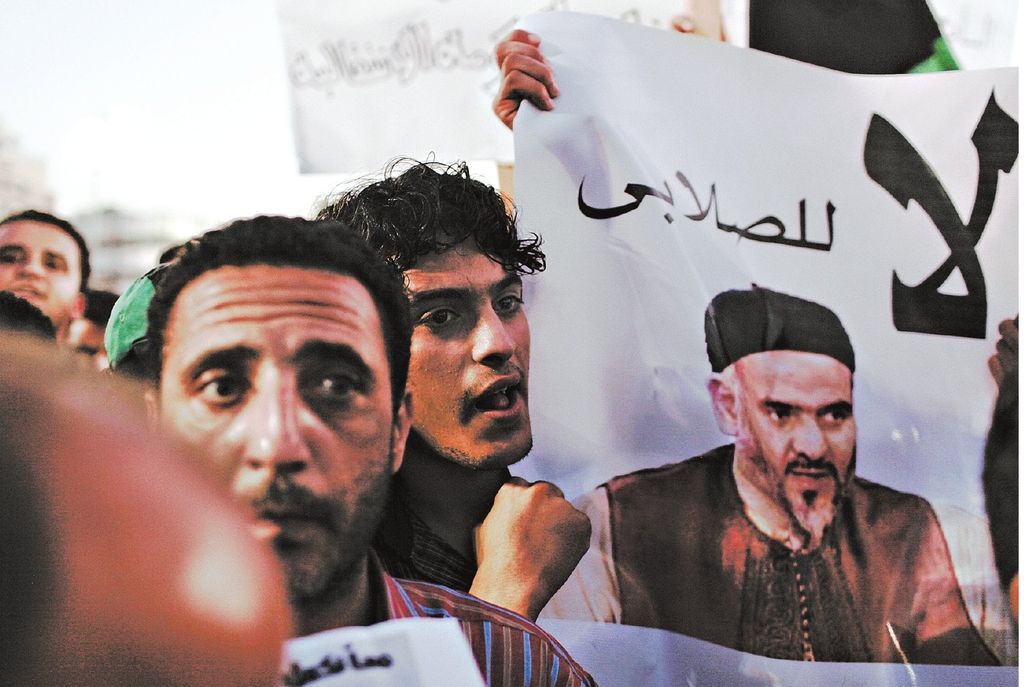
In Libya, Ali Sallabi, the most important Islamist political leader, cites Mr. Ghannouchi as a major influence. And Abdel Moneim Abou el-Fotouh, a former Muslim Brotherhood leader who is running for president in Egypt, has joined several new breakaway political parties in arguing that the state should avoid interpreting or enforcing Islamic law.
In Syria, debates still rage among activists over whether a civil or Islamic state should follow the dictatorship of Bashar al-Assad, if he falls. The emergence in Egypt, Tunisia and Syria of Salafists, the most inflexible currents in political Islam, is one of the most striking developments in those societies. ("The Koran is our constitution," goes one of their sayings.)
But when Mr. Erdogan expressed hope for "a secular state in Egypt," meaning, he explained, a state equidistant from all faiths, Brotherhood leaders immediately lashed out, saying that Mr. Erdogan's Turkey offered no model for either Egypt or its Islamists.
Indeed, Mr. Tamimi, the scholar, argued that some mainstream groups like the Brotherhood were feeling the tug of their increasingly assertive conservative constituencies, which still relentlessly call for censorship and interestfree banking.
"Is democracy the voice of the majority?" asked Mohammed Nadi, a 26-year-old student at a recent Salafist protest in Cairo. "We as Islamists are the majority. Why do they want to impose on us the views of the minorities - the liberals and the secularists? That's all I want to know."