Tiskane izdaje

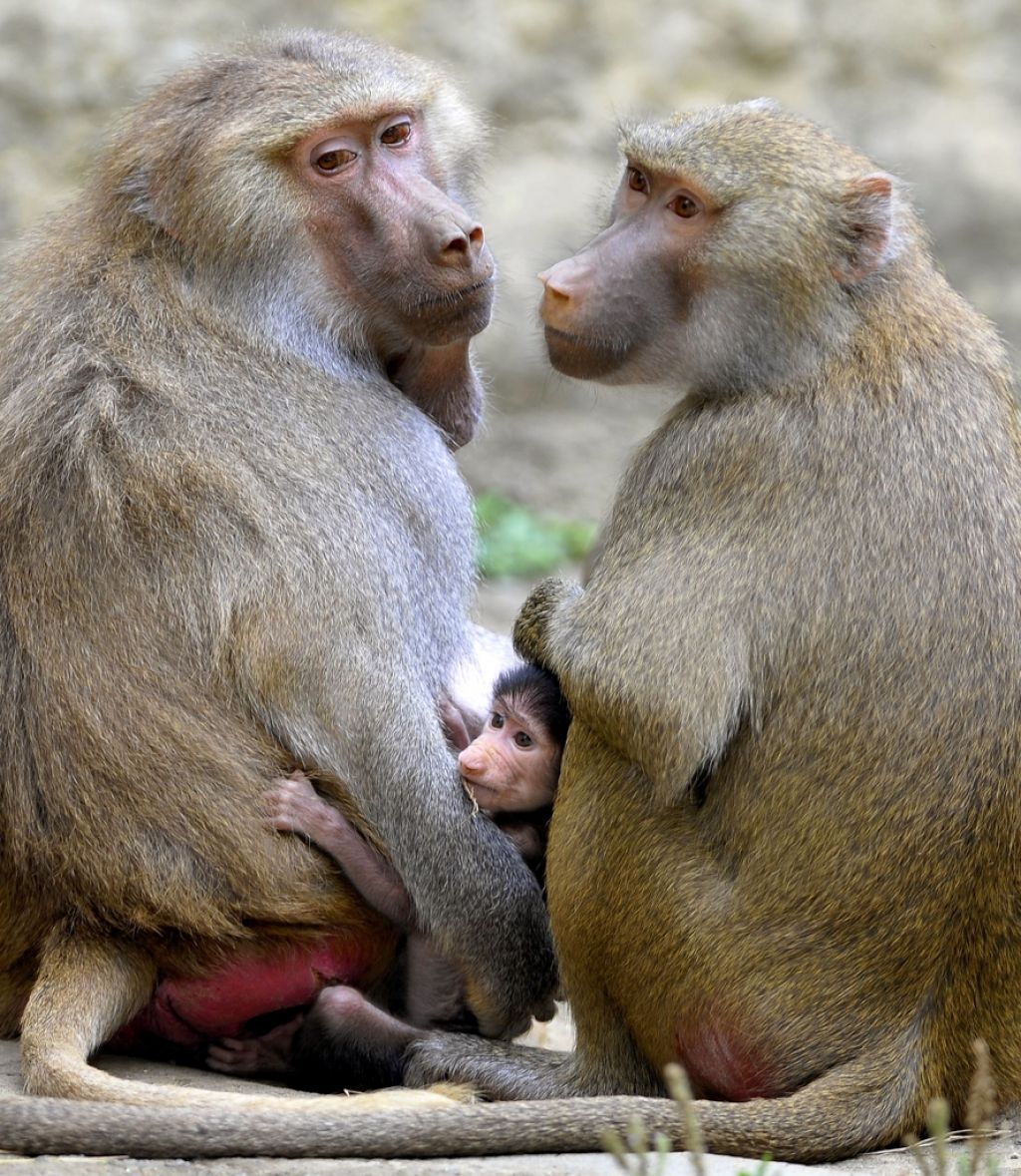


Social behavior among primates - including humans - has a substantial genetic basis, a team of scientists has concluded
from a new survey of social structure across the primate family tree.
The scientists, at the University of Oxford in England, looked at the evolutionary family tree of 217 primate species whose social organization is known.
Their findings, published in the journal Nature, challenge some of the leading theories of social behavior, including: That social structure is shaped by environment - for instance, a species whose food is widely dispersed may need to live in large groups. That complex societies evolve step by step from simple ones.
And the so-called social brain hypothesis: that intelligence and brain volume increase with group size because individuals must manage more social relationships.
By contrast, the new survey emphasizes the major role of genetics in shaping sociality. Being rooted in genetics, social structure is hard to change, and a species has to operate with whatever social structure it inherits.
If social behavior were mostly shaped by ecology, then related species living in different environments should display a variety of social structures. But the Oxford biologists - Susanne Shultz, Christopher Opie and Quentin Atkinson - found the opposite was true: primate species tended to have the same social structure as their close relatives, regardless of how and where they live.
The Old World monkeys, a group that includes baboons and macaques, live in many habitats, from savanna to rain forest to alpine regions, and may feed on fruit or leaves or grass. Yet all have very similar social systems, suggesting that their common ancestry - and the inherited genes that shape behavior - are a stronger influence than ecology on their social structure.
"We were trying to test accepted models of social evolution and have shown that in primates it happens via a different pathway than we always assumed," Dr. Shultz said.
The researchers suggest that sociality emerged about 52 million years ago. The earliest primates sought safety by being solitary and inconspicuous, moving only at night. It seems that when they shifted to daytime activity, they sought safety in numbers.
It was from these loose, unstructured groups that more specific forms of primate social behavior began to evolve, some 16 million years ago. These included pair bonding, an arrangement adopted by gorillas and humans, and the multi-male, multi-female groups typical of baboons and chimpanzees. The Oxford survey confirms that the structure of human society, too, is likely to have a genetic basis, since humans are in the primate family, said Bernard Chapais, an expert on human social evolution at the University of Montreal.
"Evolutionary change in any particular lineage is highly constrained by the lineage's phylogenetic history," Dr. Chapais said, referring to the evolutionary family tree.
"This reasoning applies to all species, including ours," he said. "But in humans, cultural variation hides both the social unity of humankind and its biological foundation."