Tiskane izdaje

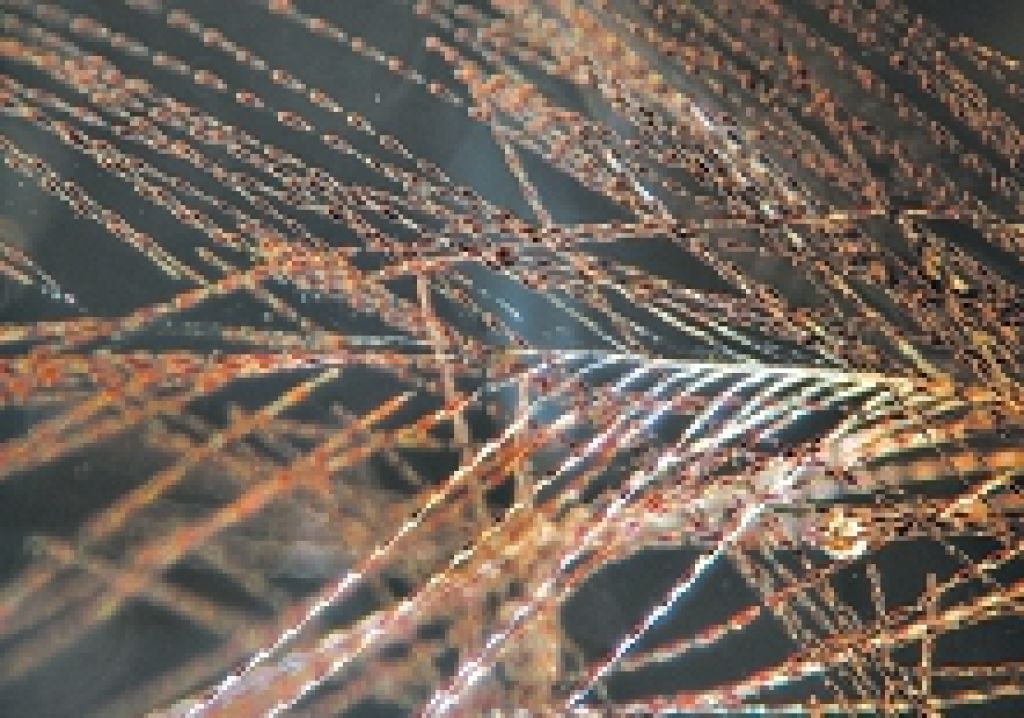


Color is coming to the formerly black-and-white Mesozoic world of dinosaurs and early birds. Not exactly high-definition color, and some formidable characters may show up in the same old drab and scaly wardrobes; they are dinosaurs, after all, with a reputation for resistance to change.
But in time, you can look for splashes of color in museum dioramas of feathered figures from the age of dinosaurs. For more than a decade, hardly a season has passed without more discoveries of dinosaur and bird fossils in China bearing impressions of feathers and traces of chemical coloring agents. Now, in Canada, paleontologists have found 70-million-year-old amber preserving 11 specimens showing a wide diversi ty of
feather types at that time.
One specimen of so-called protofeathers had a single bristlelike filament and some simple clusters. Others
were complex structures with hooklike barbules that act like Velcro; in modern birds, this keeps feathers in place
during dives. Still other specimens revealed feather patterns for flight and underwater diving.
Preserved pigment cells encased in the amber, along with other evidence, suggested that the feathered animals
had an array of mottled pat terns and diffuse colors like modern birds, scientists at the University of Alberta, led by Ryan C. McKel lar, said in a repor t publ ished in the journal Science.
Dr. McKellar's team said the amber pieces, though small, "provide novel insights regarding feather formation."
The preserved f i laments "display a wide range of pigmentation from nearly transparent to dark," but "no larger-scale patterns are apparent."
The amber was collected from mine tailings at Grassy Lake, near Medicine Hat in southern Alberta, and is housed
at the University of Alberta and the Royal Tyrrell Museum of Paleontology.
Dr. McKellar said that no body fossils of feathered creatures had been found near the amber, but that investigations of the site would cont inue.
In a commentary accompanying the report, Mark A. Norell, a dinosaur paleontologist at the American Museum of
Natural History in New York, noted that only now, with these amber specimens added to the Chinese finds, "are we beginning to understand just how diverse feather types were in the Mesozoic," roughly the age of dinosaurs from 250 million to 65 million years ago.
Dr. Norell went on to point out that amber preserves "not only the microstructure, but the actual visual color as
well - features not preserved in typical compression fossils." In other amber 94 million years old, he said, the feathers did not appear to be as diverse.
Another research approach is being tested by a team led by Roy A. Wogelius of the University of Manchester in England. In the same journal, they report results of an advanced X-ray method for detecting minute geochemical traces, including metals like copper, that are long-lived biomarkers of coloring agents in feathered fossils.
"This is an exciting technique, a powerful technique," Dr. Norell said in an interview, "but i t is in a very preliminary state and needs to be refined a bit ."
Although "research into fossil feathers is still at a nascent stage," Dr. Norell wrote, evidence is mounting that feathers were part of the earliest stages of dinosaur evolution, and now "we are filling in the colors."