Tiskane izdaje



Moscow — »We live in a normal country,« Ivan Urgant, a popular television personality, recently assured Russian viewers. The setting did not exactly support his point, since he was standing in a mock courtroom on a popular daytime show called »Fashion Verdict,« which prosecutes women for dressing badly. »Fashion Verdict« has a dizzying format — part makeover show, part show trial — but like a lot of Russian television it's a whimsical, overdone adaptation that somehow suits the national spirit.
Television over the last 10 years has mirrored the country's economic recovery, reassuring Russians that they live in a modern, and normal, country. Yet change is in the air.
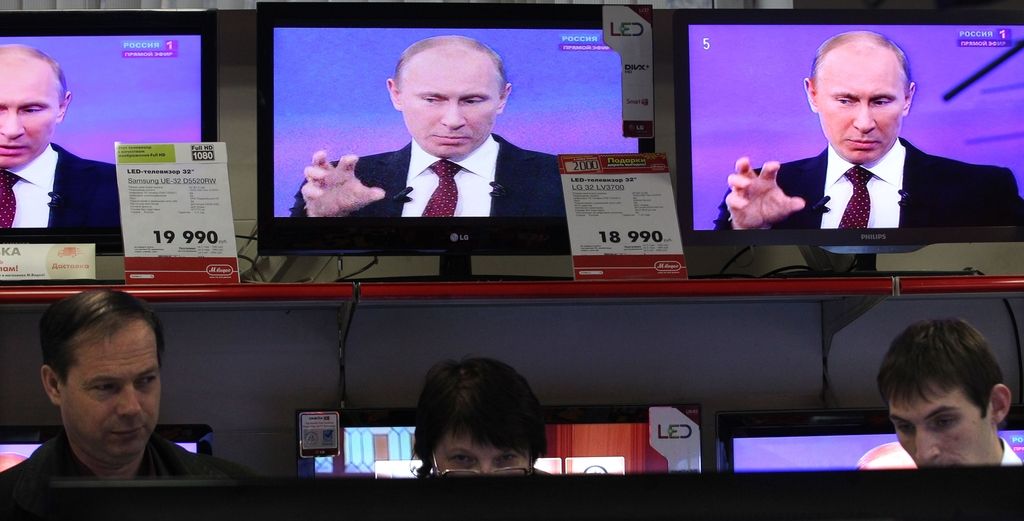
Protest and opposition to Vladimir V. Putin, the prime minister, is sneaking onto the news. And with elections coming on March 4, Mr. Putin’s relationship with television is like a marriage that seems fine until minor differences look irreconcilable.
Television is Mr. Putin’s medium, and he takes his macho stunts seriously. Whether it’s hunting for tigers or scoldinglazy bureaucrats in staged meetings, Mr. Putin does it all with a straight face. That kind of grandiosity grates in a TV universe that is playful and self-aware.
»Let's Get Married!« is a dating show that brings a jolt of Slavic fatalism to romance: the bachelor has his choice of three eligible and comely young women, but first he must listen to the advice of a panel of older women. Also, for no better reason than a flair for excess, the bachelor and his prospective brides sometimes wear theme costumes: he as Aladdin and they as a harem of belly dancers.
The cheeky, knowing tone assumes that viewers can enjoy nosy Russian yentas — and laugh at themselves.
There's plenty of humor on Russian television, though not much political satire. But some of the harsher realities of Russian life creep into even escapist entertainment. One of the most popular procedurals of all time is »Glukhar,« which finished its last season at the end of 2011. It is about a police inspector, Sergei Glukharyov, who is a loyal son, hard worker and talented detective who occasionally accepts bribes.
Kseniya Sobchak, the socialite daughter of Anatoly Sobchak, an early reformer and Putin ally, who died in 2000, was a defendant in 2009 on "Fashion Verdict," on which she was accused of dressing provocatively and too expensively. Ms. Sobchak has since become a face of the Twitter protest movement. This month she began hosting a weekly talk show on Russian MTV.
Since so many young viewers have defected to the Internet, television audiences tend to be older in Russia. They make up Mr. Putin’s political base, and his campaign courts them with class warfare, using state-controlled news programs to paint anti-Putin activists as privileged urban elites out of touch with real Russians. But that hasn't prevented evidence of Mr. Putin's newly shaky standing from finding its way onto TV screens.
Some of the celebrities whom viewers know best have turned against Mr. Putin. Alla Pugacheva, the country’s mosten during pop diva, is supporting one of Mr. Putin’s opponents for president.
Russia's silent majority isn't so silent anymore. »Let Them Talk« mashes up stagy, violent disputes with self-help advice. It's cheaply exploitative, of course, but it's also a master class on tackling taboo subjects. It doesn't criticize the government, but it also exposes social problems that are rarely discussed aloud, giving voice, for example, to people with severe handicaps who tend to be shunted off to institutions.
The Soviet past is never out of the picture for long. A new Russian sitcom, »The Eighties,« takes a wistful look back at the Mikhail Gorbachev years, when change was in the air but not yet on the streets. It's a timely flashback: it summons an era when many Russians first began hoping that they would someday live in a normal country.